Poaceae
(Grass family)
Monocot

Shoots
Leaf
-
Start at nodes, first as a sheath that wraps around the stem, and extends into a long blade
-
Leaves have parallel veins
-
Growth- New leaves grow in layers inside older leaves
Stem
-
Typically hollow, while nodes (joints) are solid
-
May spread using stolons (above-ground runners) or rhizomes (underground stems), which can produce new shoots
Storage
-
Underground Storage Organs (USOs)
-
Rhizomes
-
Tubers
-
Corms/Bulbs
-
-
Cellular Storage
-
Parenchyma
-
Endosperm
-
Fusoid cells
-
Growth
-
May spread using stolons (above-ground runners) or rhizomes (underground stems), which can produce new shoots
Roots
Root types
-
Primary Root: The initial root from the seed.
-
Seminal Roots: Early roots from the embryo.
-
Crown Roots: Adventitious roots from underground stem nodes, crucial for establishment.
-
Brace/Stilt Roots: Adventitious roots from above-ground nodes, like in corn
Roots
-
Dense, fibrous system of adventitious roots that grow from stem nodes, instead of a taproot
-
Forms a bushy network that spreads near the soil surface to hold soil and absorb water/nutrients
Flowers
Stamens

-
Typically 1-3, featuring large anthers that produce abundant pollen
Pistil

-
Simple, with a large, bushy stigma (to catch windblown pollen)
________________________

Ovary
-
Superior ovary
-
Irregular and reduced (simplified) as an adaptation for wind pollination
-
Most are hermaphroditic, though some, like corn, are monoecious.
-
Arranged in an inflorescence called a spikelet, which contains smaller units called florets
-
Each floret is enclosed by 2 bracts: the lemma and the palea
-
The entire spikelet is enclosed by another pair of bracts called glumes
-
Sepals
(Calyx)
-
Absent, or reduced to 2 small scales called lodicules
-
Absent Corolla
Flowers
Fruit
Fruits

-
Usually a dry caryopsis commonly known as a grain
Did you know?
-
It is the fourth largest plant family – contains approximately 600 genera and 10,000 species

Photos
Whole Plant


Variations
 sorgum |  Bamboo |
|---|---|
 Wheat | 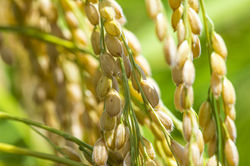 Rice |
 Barley |  Oats |
 Lawn Grass |
Works cited
https://www.apnikheti.com/en/pn/organic-crops-detaills/rice
https://en.wikipedia.org/wiki/Barley
http://www.youtube.com/watch?v=aVoXVmg589M
https://youtu.be/xmdsFhtwUYs?si=DMF1rsTCkkGMvFyf
https://ohioplants.org/families-poaceae/
https://www.sciencedirect.com/topi
cs/agricultural-and-biological-sciences/poaceae
https://youtu.be/GEh47cY9I4I?si=YcBdvjjaZ5ksPawO
https://ecosystemsunited.com/the-importance-of-annual-grasses/
https://www.life.illinois.edu/help/digitalflowers/Fruits/39.htm
http://www.youtube.com/watch?v=Shjs9qC7k5k
http://www.youtube.com/watch?v=x2OyWWww56M